Dr Tomasz Mońko
organist, performer and improviser, electronics designer, programmer and automation engineer
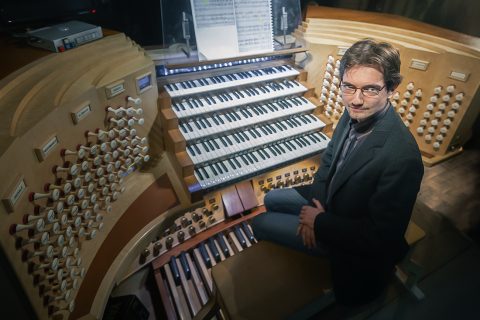 his fascination with organ music, performance
and the construction of musical instruments began in early
childhood. Music soon became his lifelong passion, eventually
developing into his profession as an organist, performer,
improviser and educator. He graduated from the Academy of
Music in Łódź, where he studied organ with Professor
Mirosław Pietkiewicz. He has also taken part in numerous
seminars and specialist consultations.
Throughout his childhood, he was equally fascinated by electricity, electronics, physics and computers. Through independent study and with the encouragement and support of his father, he was able to develop his knowledge and practical skills in these fields alongside his musical education. Access to the physics laboratories at the Łódź University of Technology proved particularly valuable. There, at a very young age, he learned to write simple computer programs, laying the foundations for his subsequent development in programming and engineering. These diverse interests and passions ultimately came together in his graduation thesis, which explored the history and future of organ building, with particular emphasis on the development of key and stop actions and the possibilities offered by innovative applications of electronics and computer technology. An original prototype of a performance-assistance device, independently designed and built by the author, accompanied the thesis. The work received the highest possible assessment.
Dr Mońko's doctoral dissertation, awarded a distinction, entitled "New Means of Artistic Expression in Organ Literature and Improvisation Through the Application of a Mechatronic, Programmable Key-Action Control System", continued his research at the intersection of science and the arts. As part of this doctoral project, he designed and built a pipe organ incorporating prototype mechatronic modules for controlling the valves of the windchests. The artistic component of the dissertation took the form of a recording in which the author, primarily through improvisation, demonstrated the newly developed means of artistic expression.
Tomasz Mońko has performed in numerous cities throughout Poland and abroad, presenting primarily repertoire from the Baroque period, as well as improvisations inspired by twentieth-century symphonic organ music. He has also taught liturgical organ playing and organ improvisation at the Academy of Music in Łódź. Over the years, he has undertaken numerous commissions involving the design of digital devices and more sophisticated electronic systems. He has also taught courses in Embedded Systems, Computer Control and Robotics at a university in Łódź. In 2010, he began collaborating with Tomasz Uliński. This partnership led to the creation of OrgNG, a comprehensive microprocessor-based control system for pipe organs. Its features include controllers for the key and stop actions, a next-generation combination action (setzer), MIDI encoding and decoding, and an energy-efficient controller for electrically operated actions. Today, working together under the name T2Logic, they continue to develop innovative solutions for organ automation while refining and enhancing existing technologies. In 2016, they created the first system of its kind in Poland, installed in a church in Gdynia. The system enabled two pipe organs and two consoles to be connected wirelessly, using the OrgNG3.0 system.